The Lithium Market has a new bear narrative – and why we think it’s wrong
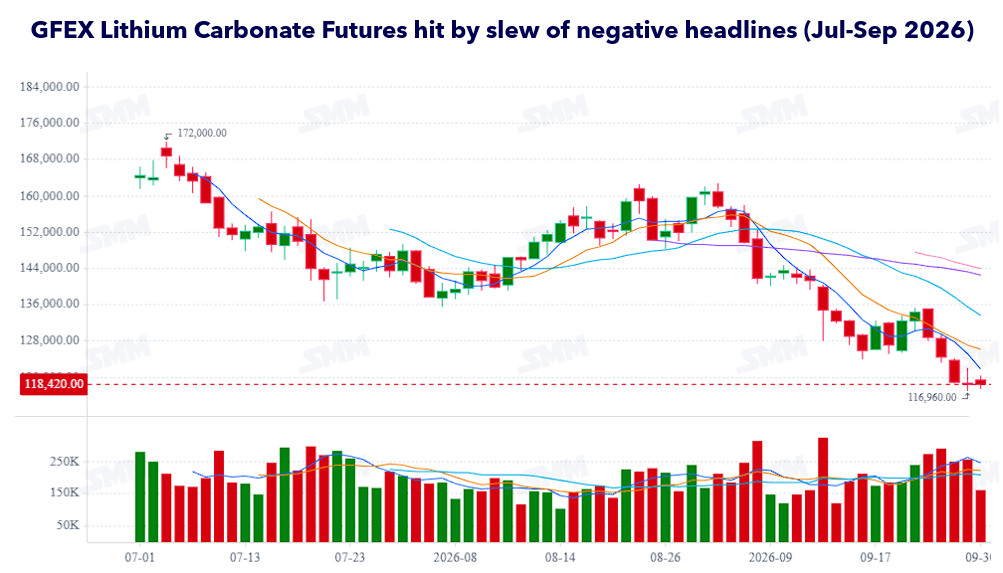
On the final day of the quarter, Bloomberg published a story titled “Lithium Plunges 25% in China on Fears Over Battery Demand Growth.” Over the last three months, a series of negative headlines had hit the lithium sector one after another, causing a rush to the exits amongst GFEX (Guangzhou Futures Exchange) traders and in the equities markets. We list these headlines first, and will provide the context and outlooks after:
- June: Bloomberg: “Lithium Plunges in China on Speculation Over Status of CATL Mine”
- July: CNEVPost: “CATL restarts Jiangxi lithium mine with 100,000-ton annual capacity”
- July: Reuters: “China to levy consumption tax on lithium-ion batteries and solar cells”
- August: Mining.com: “CATL mine shutdown threatens to flip lithium market into deficit”
- September: Reuters: “China pauses approvals for battery storage manufacturing projects”
- September: Bloomberg: “Lithium’s inventory upheaval confounds industry, hits prices”
- September: Bloomberg: “Lithium Plunges 25% in China on Fears Over Battery Demand Growth”
- October: Bloomberg: “Chinese Lithium Slumps 10% After EU Deal Slashes Hybrid Exports” / Reuters: “China, EU strike deal to halve Chinese hybrid exports”
(1): The Jianxiawo mine that we spent a significant part of the June letter explaining caused huge waves in the market from June to August, threatening the resumption of 60-100kt lithium carbonate equivalent (LCE) of supply, equivalent to 3-5% of global supply this year. We noted that CATL had used newsflow of this mine restarting to push lithium prices down throughout the year. We estimate that this mine provides 10% of CATL’s lithium needs – by making a loss on the mine and crushing global lithium prices, it vastly lowers its raw materials costs for the 90% it purchases.
(2): Multiple news sources reported CATL restarting the Jianxiawo mine, with Benchmark Mineral Intelligence monitoring the site via satellite imagery. When CATL secured a so-called safety production permit on 29 June, Benchmark reported the site resumed activity almost immediately.
(3): Chinese regulators removed lithium from consumption tax exemption, levying a 2% tax starting from Sep 2026 which will rise to 4% in Sep 2027. This is not the 13% country-wide VAT – it is a special tax that is used to nudge consumer or producer incentives in specific industries like tobacco, alcohol, luxury vehicles, petroleum, luxury goods, etc. The reason for imposing this tax on lithium was to curb the overcapacity at the cell manufacturing sector (in line with the anti-involution drive), to pressure low-margin inefficient producers to consolidate or exit the market.
Some market commentators speculated that this would chill EV-car demand – but Caixin Global estimated the 2% rate would add only CNY 500 to a car’s price. This works out to 0.3-0.5% of a car’s price, thus we see no impact at the consumer level from this tax.
(4): The only good piece of news for the lithium industry this quarter, allowing the futures price to rebound from CNY140k/t to CNY160k/t. However, the lithium price did not recover to the CNY170k-180k/t level that was prevalent before the Jianxiawo mine restart saga.
(5): This headline was misread in a number of ways. Multiple media articles headlined a pause in “new battery projects” or “new energy-storage capacity”, which created confusion. It was not the containerized-battery projects (BESS) that were being stopped – but new battery manufacturing capacity.
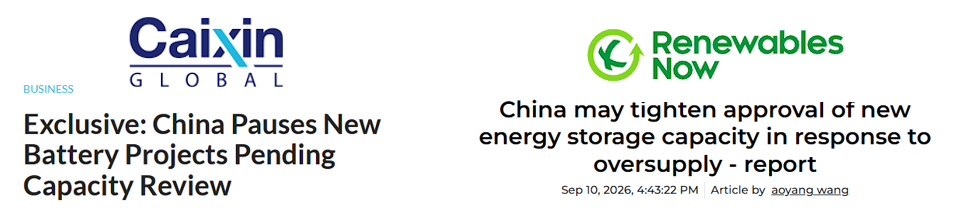
Second, only projects still in the planning and approval stages were stopped. Manufacturing plants that had been approved or had begun construction were not affected. The net impact to real demand will be far smaller than the headlines suggested.
Third, the headlines were read without context. With current expansion programs, domestic production capacity for BESS cells would grow to 1,200-1,500GWh by the end of this year, with a planned total that had surged to 2,000GWh, almost double global annual demand. The Chinese Government was nipping a future overcapacity problem in the bud, which is healthy for the lithium industry overall.
(6) The change in inventory methodology by the Shanghai Metals Market (SMM), an authoritative source on China’s metals industries, was the most damaging headline and upended the lithium price. The original inventory number had been 79kt LCE, and the new number was 170kt LCE, an increase equivalent to 5% of annual supply. This sent lithium tumbling down 20% over multiple sessions.
SMM revised its methodology to “optimize and expand its data coverage”, expanding its data classification from three to four categories. It added a dedicated category for battery cell plant and other inventory (the other three original categories were upstream smelters, cathode material plants, and trade inventory).
The GFEX price had run up to the CNY170-200k/t level in the first half of the year as inventories fell and a deficit narrative started to build in the market. This tightness was partially alleviated by the high-cost Australian mines restarting and the massive Manono mine in Congo starting production in July. However, the seemingly magical discovery of another 90kt LCE of inventory caused the market to take fright.
However, let’s take a step back and look at the big picture. The lithium demand is running at 2,100kt LCE this year and 2,700kt LCE next year by our model. The 170kt LCE inventory number is a mere 23 days of next year’s demand, hardly high. SMM itself forecasts a deficit of ~20kt LCE per month for Sep-Dec, which would send the inventory number right back to the 80-90kt level that sparked the entire bull run.
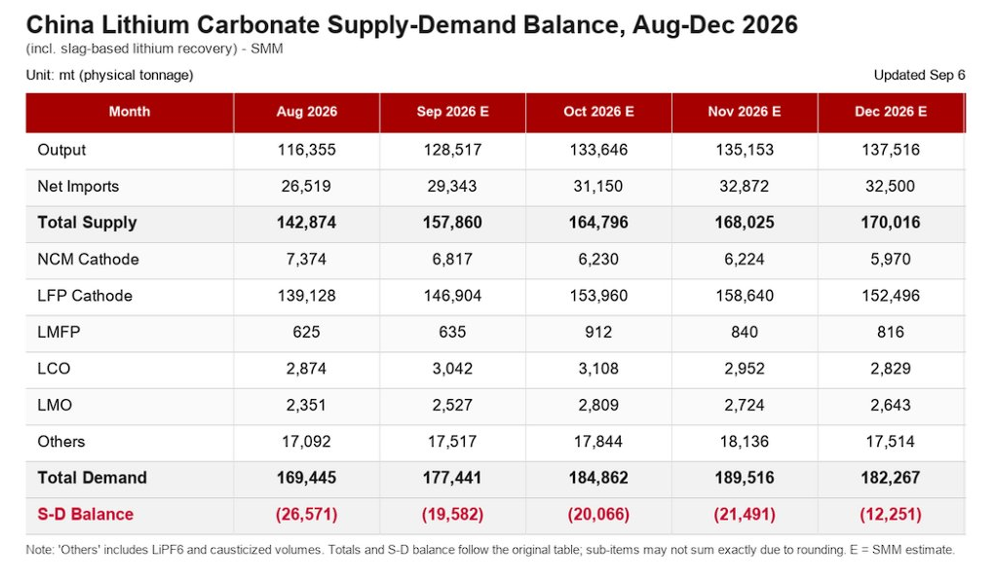
So while we acknowledge that the revised inventory number had some fundamentally-logical impact on the short-term lithium price, we believe the deficit has merely been postponed by a few months.
As of the first week of October, this inventory number had already fallen to 139kt.
(7): The Bloomberg headline of a 25% fall was reporting on the Sep month fall, entrenching bearish sentiment in the market. It also referred to the “consumption tax” as a headwind on the industry, which was the prevalent market chatter when the article was published, but that worry has since been refuted.
(8): GFEX Lithium Carbonate futures actually fell 12% (maximum daily limit) that day, more than the headline. We think this is a massive overreaction to a negligible impact on lithium demand. Our calculations show that this result reduces overall lithium demand by 0.4% of the market!
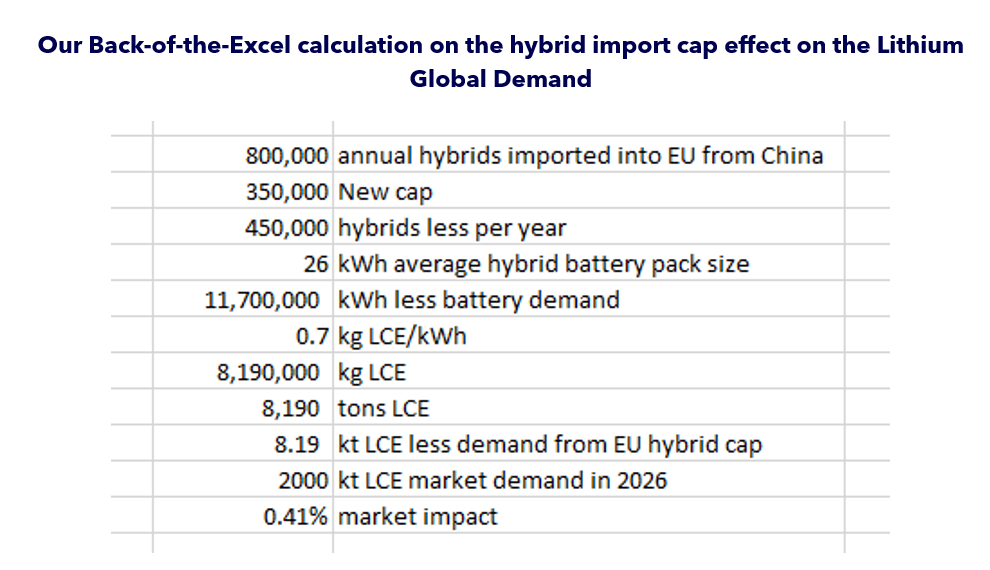
The larger context of this cap on hybrid imports into the EU is this: hybrid sales had been surging in the EU in recent months as they had been excluded from 8-35% tariffs faced by pure battery electric vehicles (BEVs) imported into the EU. This change merely closed the loophole, while being a small part of the give-and-take of the larger EU-China trade deal happening today.
The broader direction is for Chinese carmakers to set up factories in the EU to produce pure BEVs, given the EU’s general aim of transitioning to zero-emission vehicles. The fact also is that pure BEVs are outselling hybrids globally this year by a factor of 2:1, with hybrids having been the transition technology to pure BEVs for many drivers. The new automobile factories in the EU will eventually lead to greater lithium demand, making this hybrid cap a complete non-issue on the grander scale.
The fact that the GFEX price crashed 12% in reaction to this headline shows the extreme bearishness of the market, a situation where we like to be buyers rather than sellers.
The conclusion of this post is – the narrative on the lithium market had completely reversed due to the slew of negative headlines. But fundamentally, little has changed. Even at CNY107k/t where the GFEX sat in early October, ex-VAT this is US$14k/t where producers continue to make 57% gross margins. Meanwhile, lithium miners’ equities have crashed 20-40% YTD, and as much as 70% off their May peaks. There is much value to be found here.
Leave a Reply