19 Nov 2026
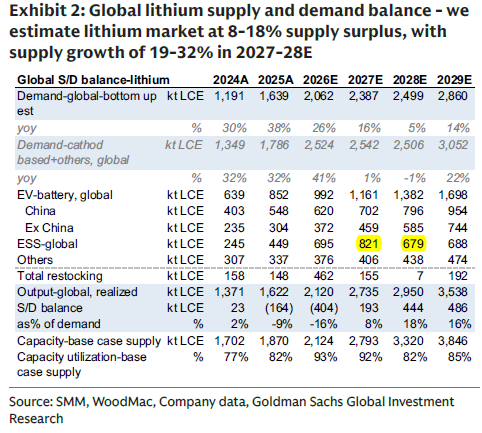
Early October, Goldman Sachs published a very bearish report on the lithium sector, forecasting surplus in the market again from 2027 to 2029+. The crux of their thesis hinges on BESS peaking in China in 2027, and falling thereafter.

Focusing on the highlighted section: GS expects lithium demand from global ESS to peak at 821kt LCE next year, and fall to 679kt in 2028. The obvious question: Is ESS truly peaking in China?
Is ESS truly peaking in China?
The YES case says:
BESS installations fell 18% YoY in China in 1H 2026: For the first time in history, after years of triple-digit growth, BESS installations in China fell 18% YoY in GW terms, to 22.2GW / 59.3 GWh according to official statistics from the China Energy Storage Alliance (CNESA). This was the result of a policy change in Feb 2025 (NDRC Document No. [2025] 136), where BESS was made non-mandatory in new solar/wind projects.
The policy was changed because the Chinese Govt realized that mandatory BESS projects were running only ~200 cycles per year, about 100-150 cycles less than standalone market-driven BESS projects. In other words, administrators of those mandated projects were viewing them as policy checkboxes instead of a revenue driver. The Govt removed the co-location mandate in favour of a more market-driven approach to BESS installations.
The removal of this mandate naturally caused a disruption in BESS project flows, with the lagged effect appearing in 1H 2026 installation numbers.
News from China reports 5% IRR at CNY200k/t lithium prices, stalling demand. This was true in May when lithium prices were double what they are today, but also in the context where electricity price arbitrage was the only source of revenue for BESS projects. The Chinese Govt realized that with the move towards non-mandatory, market-driven BESS, they needed to incentivize this shift. The NDRC Document No. [2026] 114 sets out national capacity compensation frameworks for standalone storage, offering reliable payments guaranteeing baseline revenues in return for these BESS projects providing peak-shaving capacity and ancillary services, stacking on top of the electricity price-arbitrage returns. With these changes, the IRRs are doubling towards 10-13%.
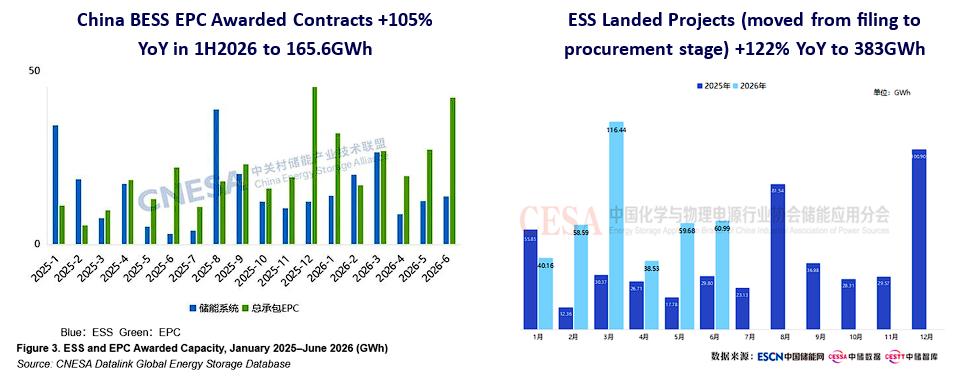
With lithium prices now halved and the revenue-stacking model emerging in China, we expect a new wave of BESS demand. Indeed, the latest figures bear this out – the project pipeline is strong at 105-122% growth YoY.
The NO case to Goldman’s ESS-peak argument has some stronger arguments for it:
ESS tenders in China are moving up from 2-hour to 4-6-hour sizes. In the first half of the year, tendered power reached 24.5GW (down 3.4% YoY) while energy capacity jumped to 148.1GWh (+88.3% YoY), averaging 6.04 hours.
Economics partly drove this. The average winning bid for two-hour systems was CNY602/kWh, where four-hour systems prices were CNY541/kWh. Four-hour systems were cheaper on a unit basis than two-hour systems, reflecting their economies of scale. There is little data on six-hour systems, but we believe they should be near the four-hour system price per kWh.
The Chinese 15th Five-Year-Plan calls for 300GW of BESS, with ~140GW existing before the update to the 15th plan. Typically, China sets these high-level figures conservatively, and proceeds to exceed them over the five years. Modelling for a modest outperformance, an additional 200GW of power at 6 hours, China’s ESS demand would be 1.2TWh, or 240GWh per year. This represents yet another step up from the 189.5GWh installed in 2025, and 83.0GWh installed in 2024.
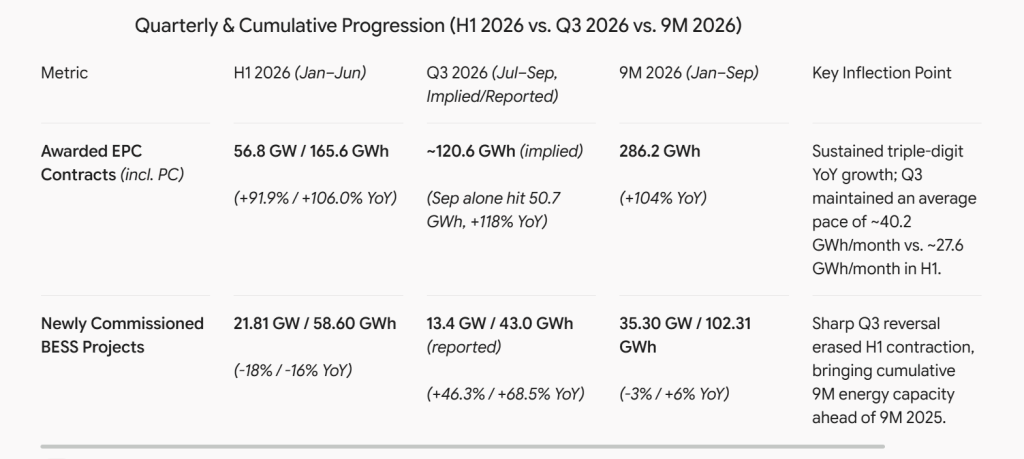
3rd Quarter 2026 figures are STRONG! The negative BESS news was the -18% YoY fall in GW installed. That reversed in 3Q 2026, with installations up 46.3% and 68.5% YoY in power and energy terms respectively.
But the real forward-looking numbers are in the “Awarded EPC Contracts” data. At a 9M 2026 growth of +104%, there is clearly no sign of slowing. September alone hit 50.7GWh, a massive re-acceleration.
The 15th Five Year Plan also makes ESS a central pillar, and to achieve synergies with AI. “Energy storage 储能” is mentioned 14 times in the NDRC’s “15th Five-Year Plan for the Construction of a New Energy System” (NDRC Document No. [2026] 884). “Computing electricity synergy 算电协同” made its first-ever mention, signalling the Govt making ESS a core pillar to support AI datacentres.
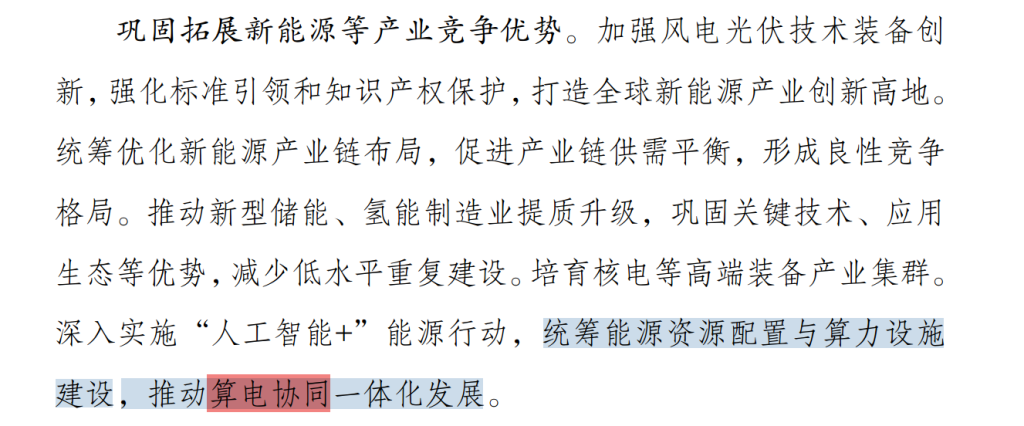
Our thesis is simple, and hopefully powerful – when the Chinese Govt makes something a core pillar in the Five Year Plan, it will not peak in the next year!
So what’s actually happening in China for BESS?
Time lags were the problem. Policy changes caused an “air pocket” for installations from Jun 2025 to May 2026. When the mandatory BESS co-location policy was removed in Feb 2025, a deadline of 1 Jun 2025 was set. Projects installed after this would enter the “Contract for Difference (CfD)” spot bidding market system. This caused a massive rush of installations in May 2025 (10GW / 26GWh), double the usual pace. Installations fell off a cliff after this.
The introduction of NDRC Document No. [2026] 114 which set out the new capacity payment framework occurred only in Jan 2026. Provincial regulators spent the first half of 2026 translating this Document 114 into concrete provincial capacity tariff lists (清单制) which have now made BESS projects in China essentially bankable again. However, during this period, developers essentially took a step back to re-assess the evolving regulatory environment, with installations trending down to a bottom in May 2026 of 1.78GW / 5.22GWh, down ~80% YoY!
However, many provinces were slow to implement Document 114, extending that air pocket. The new framework had been issued, but the on-the-ground implementation were to be managed at the provincial government level. A small number of provinces were quick – Liaoning, Inner Mongolia, Ningxia, Shandong – rolling out their capacity tariff lists within the first half of the year. Document 114 had also (probably unintentionally) reduced BESS IRRs by making “system usage fees 系统运行费” payable by BESS operators. The latest Document 1565, published in Nov 2026, reversed that decision and opened the door to provinces to cut or exempt BESS systems from this fee while charging.
The latest issue of NDRC Document No. [2026] 1565 should lead to an installation boom again, consuming the built-up inventory. This latest document is an operational manual for implementation of the BESS capacity payment framework, immediately reducing market uncertainty about BESS economics. This should lead to a re-acceleration of installations, helping to consume the gap between shipped and installed BESS systems.
This Document 1565 also explicitly laid out a 2030 target of 300 GW x 3 hours = 900 GWh of renewable storage. China, as of Sep 2026, had about 435 GWh. As we earlier pointed out, China usually sets long-term targets which they then easily exceed. We continue to believe that 4-hour systems are the new baseline, and 1,200 GWh of BESS is the true target. At the very least, this document has now set a floor for Chinese BESS demand over the next four years.
A key point: EPC orders rebounded quickly in 1H 2026, faster than installations. As soon as Document 114 dropped in January 2026 and provinces like Inner Mongolia, Ningxia, and Shandong rolled out standalone capacity compensation rules, developers immediately moved to standalone grid-side EPC tenders—pushing 1H 2026 awarded EPC contracts up 106% YoY to 165.6 GWh (88.5% of which was grid-side standalone BESS). This is, to us, the most forward-looking data.
As such, we strongly believe there is no case for BESS to peak in China in 2027, and the lithium market is likely to stay under-supplied.
Leave a Reply